PR Industry view
January 2026

Tom Lawrence
Founder & CEO - MVPR
What is Earned-First Cold Outbound?
For most B2B sales teams, outbound feels like shouting into a void. Your SDRs send tens of thousands of cold emails. LinkedIn connection requests go ignored. Conversion rates hover somewhere between disappointing and nonexistent.
Conventional wisdom says the solution is better copy, smarter sequences, more sophisticated deliverability infrastructure. Optimize your way to slightly less terrible results.
But there's a different approach that changes the economics entirely.
The Trust Crisis in Sales Outreach
Traditional cold outbound is facing a compounding problem that goes beyond deliverability.
Sales collateral and lead generation content have a trust crisis. AI-generated outreach has flooded inboxes with messages that sound plausible but feel hollow. Prospects have developed sophisticated filtering mechanisms, not just in their email clients but in their own heads. They can identify generic, templated, AI-assisted outreach within seconds.
The result is that even well-crafted, genuinely personalised messages get lumped in with the noise. The signal-to-noise ratio has collapsed, and sales teams are paying the price.
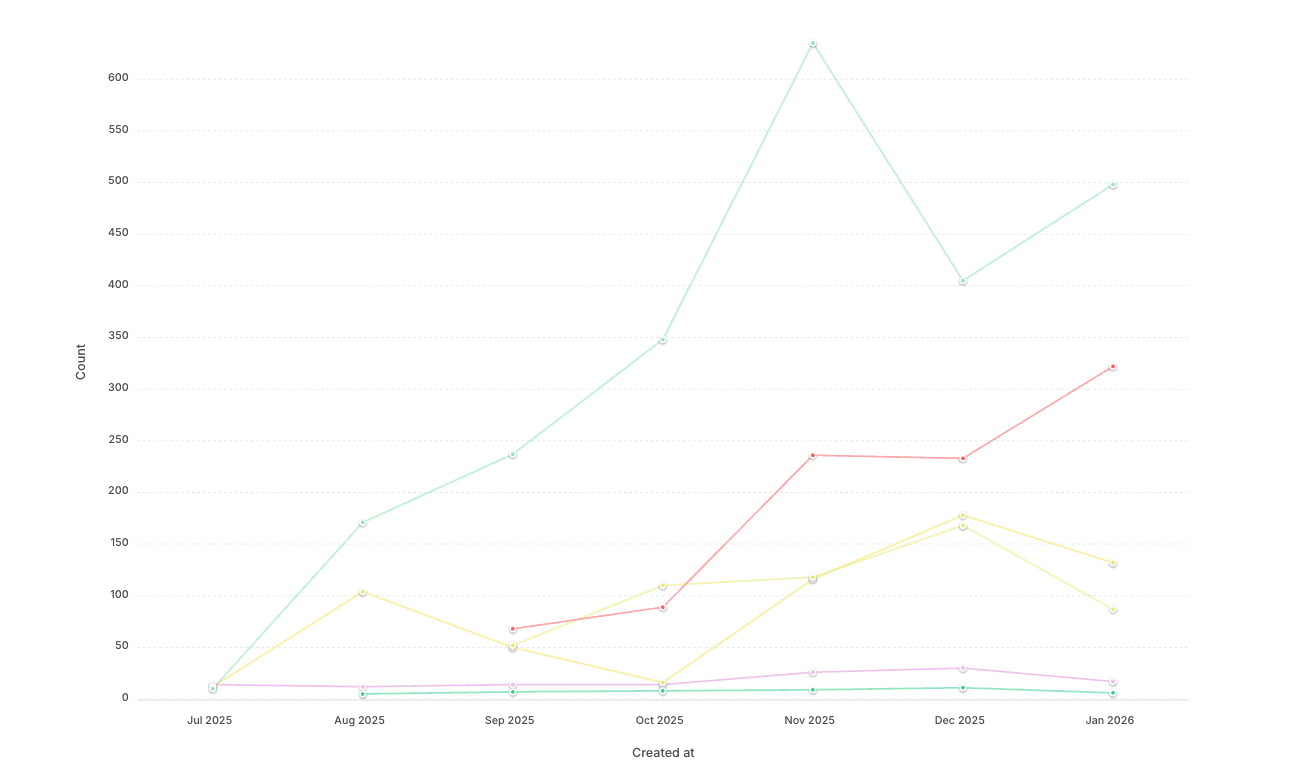
What we're seeing now - and this accelerated dramatically in Q4 of last year - is that cold outbound is becoming structurally harder. Email domains get flagged. Messages route to promotions folders or spam. Even when you reach the inbox, the default assumption is that your message is low-value, mass-produced content.
Meanwhile, sales teams are optimising the wrong variables. Better subject lines, smarter A/B testing, more sophisticated deliverability infrastructure. These are incremental improvements in a channel that's fundamentally degrading.
You're fighting for marginal gains while the underlying problem gets worse.
Earned-First Changes the Equation
Here's what earned-first outbound looks like in practice.
Instead of starting with a cold email to a stranger, you start by becoming worth paying attention to. You analyse your target prospects for signals that tell you which online and offline media they trust and you create a list of the most highly trusted media that satisfies the coverage of prospects that you need. Your company or its spokespeople publishes insights, analysis, or perspectives that are genuinely useful to your target audience. Not marketing content dressed up as thought leadership, actual signal that helps people do their jobs better. You target the media your analysis told you was high trust with your prospects and narrow your focus and energy there - ignoring the noise from your board asking why you're not in the newspaper they read on Sundays.
Some portion of your audience engages with this content - they read your newsletter that contains links to the high-trust sources, comment on your posts that summarize them, download your research that references other media, follow our blog and your analysis. They don't know they're prospects yet, but they've demonstrated interest in the problems you solve and the way you think about solving them.
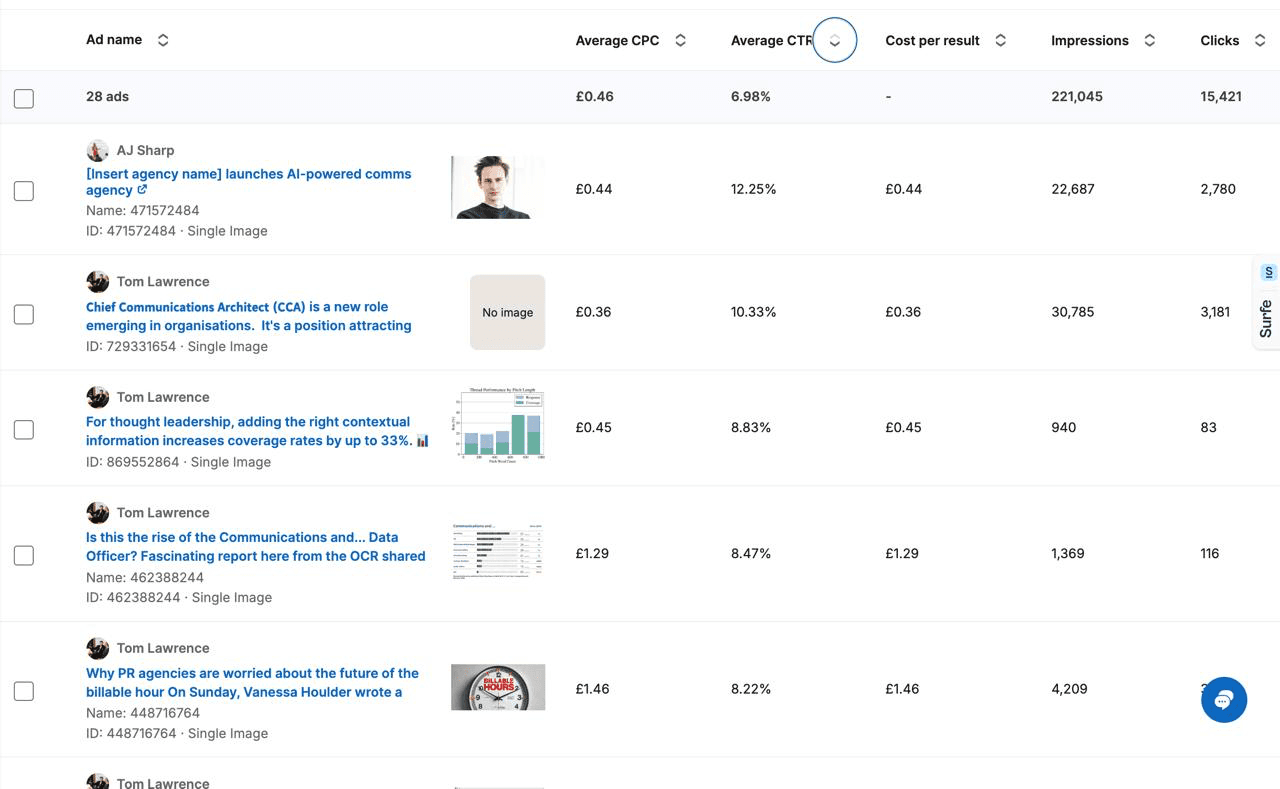
Then, when you've accumulated enough signals, your sales team reaches out - and its not cold anymore. It's higher trust by proxy.
You're not asking for attention from zero context. The SDR isn't saying "Hi, stranger, let me tell you about my product and why its awesome and solves your problem." They're saying "Hi stranger, you seem to be looking for solutions to this problem, here's some information from a source you already trust that could be valuable in helping you solve your problem. If you want to dig deeper, I'll put you in touch with the person who shared the insights in the source so that you can have a conversation about how it applies to your use case."
Whatever the delivery format, this person doesn't experience it as spam. They experience it as relevant, timely, potentially valuable. More importantly, they experience it as trustworthy, because the content they engaged with first wasn't from you - even if it was about you.
The Data Tells a Clear Story
We built a system to test this properly. Attio as the CRM core, connected to enrichment tools, integrated with email delivery infrastructure, LinkedIn and Substack for social media, our website CMS, and plugged into our own software - an OS for comms and marketing teams (MVPR), that we used to customise content for individual prospects and channels.
The system is fully automated from enrichment through to meeting booking.
We ran roughly 7,000 contacts through cold sequences - standard best practices, well-written copy, good deliverability infrastructure, all the things sales teams are supposed to do.
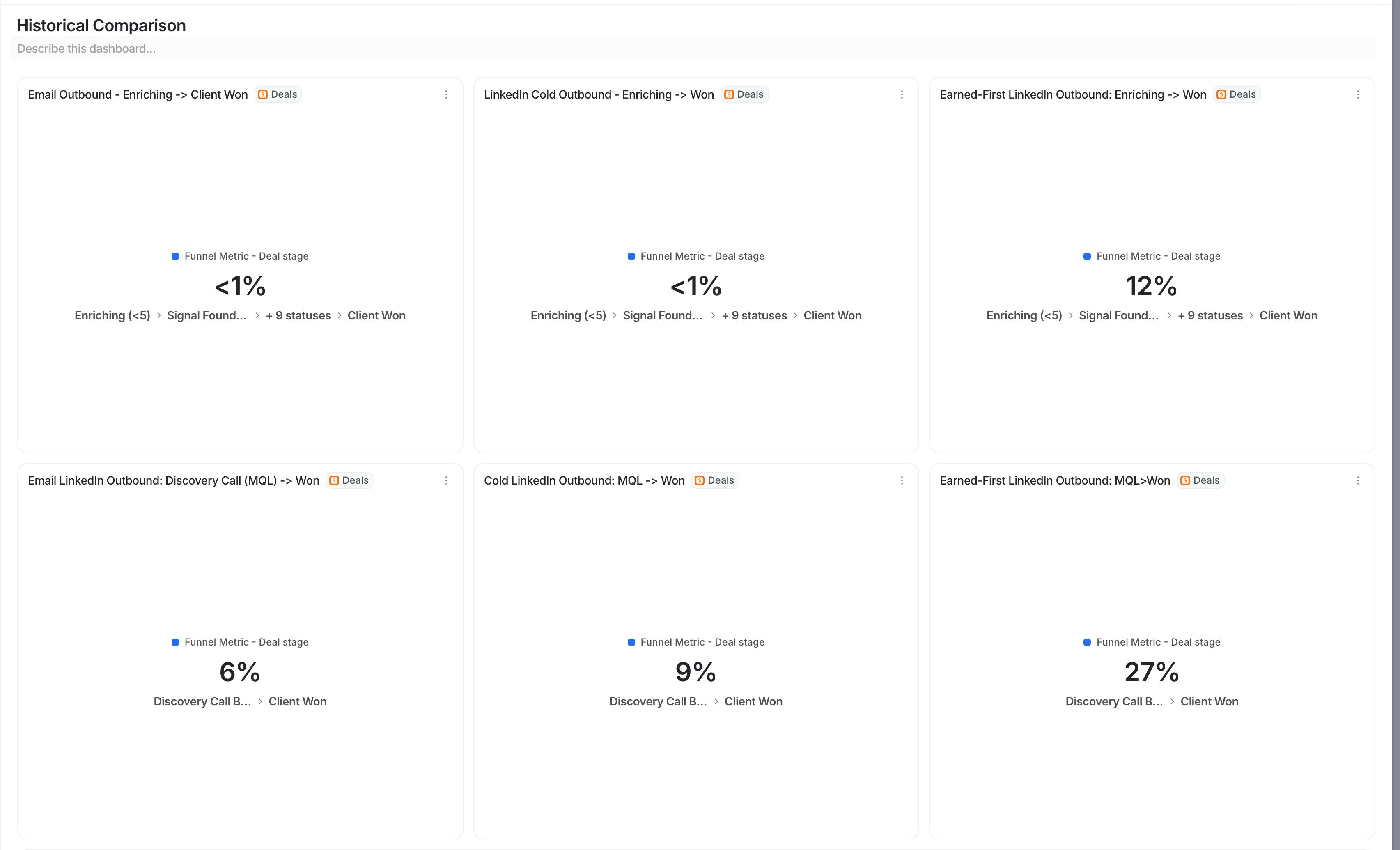
Cold email converted at 0.29% from enrichment through to closed deal. Cold LinkedIn outreach performed marginally better at 0.38%.
The earned-first sequences, targeting people who'd engaged with our content before we reached out, converted at 12.1%.
Not 12.1% better. 12.1% absolute conversion rate.
That's a 41x difference.
We also found that it produced much higher predictability for conversion after discovery calls (MQL for us). Prospects where their first touch point was cold email converted 6% of the time. Cold LinkedIn converted 9%, but where the first touchpoint was trust-wrapped: 27%. That's just under 1 in 3.
As a sales & marketing team of 1 person, it means I mainly want to be in demo calls that are earned first, because I know I can convert a new client every ~3 calls rather than every 10 calls or every 15 calls.
Why This Works: The Trust Arbitrage
The mechanics here aren't complicated, but the implications are profound.
When someone engages with your content before your sales team reaches out to them, three things change:
First, you've demonstrated competence in the domain. They've seen you think clearly about problems they care about. You're not an unknown quantity making unverifiable claims. You've already provided value, which creates reciprocity and credibility. In a world where AI can generate plausible-sounding sales messages at scale, demonstrated expertise through high-trust content becomes a primary differentiator.
Second, you've pre-qualified intent. Someone who reads your analysis of go-to-market challenges in B2B SaaS is signalling interest in go-to-market solutions. The targeting is implicit in their behaviour, far more reliable than any demographic or firmographic filter you could apply. Your SDRs aren't wasting time on people who aren't in-market.
Third, you sidestep both the deliverability decay problem and the trust crisis entirely. Earned-first messages don't build 'spam debt' - because the relationship context changes how human recipients evaluate the message. Recipients approach the message with a fundamentally different mental model. It's not "another sales pitch" - it's "oh, these are the people whose content I found useful." Much less likely to mark you as 'spam' even if the article you're sharing isn't relevant.
PR as Sales Infrastructure
This reframes what PR and thought leadership actually do for B2B companies.
Most sales teams think of PR and content as brand-building activities. Top-of-funnel awareness. Nice to have, but not directly connected to pipeline generation.
That's wrong.
High-trust content - the kind that gets published in respected industry outlets, the kind that demonstrates genuine expertise rather than marketing spin, the kind that takes a clear point of view rather than hedging every statement - functions as sales infrastructure.
It's not separate from your outbound motion. It's the foundation that makes outbound work.
When sales collateral has a trust problem, when AI-generated outreach has poisoned the well, when prospects default to skepticism about anything that lands in their inbox, earned attention through credible content becomes the unlock. Yes, you can use lead magnets, blogs, cross-posting, paid articles, but in the end, nothing beats the credibility of earned media.
Your sales team isn't fighting an uphill battle trying to establish credibility from scratch in every cold email. The credibility is pre-established. The trust is already there, at least provisionally. The sales conversation starts from a fundamentally different place.
And you can drip feed ambassadors and influencers this content to share with their networks - we call this 'trust-nesting' - e.g. take a high trust source and deliver it via a high trust channel - while still being measurable.
The Implementation Challenge
The obvious question is why every sales team isn't doing this already.
The honest answer is - it requires more time upfront and coordination between functions that often don't talk to each other properly. If you copied our system wholesale, expect 4-6 weeks to get it fully operational. You need the infrastructure to track content engagement, the enrichment tools to identify which engaged users match your ideal customer profile, the automation to trigger outreach at the right moment, and the content generation capability to personalise messaging based on what specific topics or perspectives resonated.
More fundamentally, you need the high-trust content in the first place. That requires investment in PR, thought leadership, and editorial quality that goes beyond standard marketing content. It requires taking actual positions, demonstrating actual expertise, providing actual value before you ask for anything.
Cold outbound is faster to spin up. You can be sending sequences tomorrow if you want. The barrier to entry is low, which is precisely why it's become saturated and ineffective.
Earned-first requires you to be worth paying attention to before you ask for attention. That's harder. It requires sales leaders to think about PR and content as pipeline infrastructure, not brand-building nice-to-haves. It requires marketing and sales to actually coordinate around content strategy and prospect engagement tracking.
But once you've built that capability, the conversion advantage compounds. Your content library grows, your audience grows, your pool of earned-first prospects grows, and your cost per meeting booked decreases over time instead of increasing as deliverability degrades and trust continues to erode.
What This Means for Sales Teams
The SDR industrial complex wants you to believe that outbound success is about execution. Better copy, better timing, better follow-up cadences. Optimise your way to 0.2% instead of 0.1%.
The data says something different.
The leverage isn't in execution refinement. The leverage is in becoming referable before you pitch. Not through referral programs or incentive structures, but through the simple mechanism of being useful enough that people choose to pay attention to you before you ask them to.
For sales leaders and lead generation teams specifically, this means rethinking what your tech stack actually needs to accomplish. It's not just about email deliverability and sequence automation. It's about content engagement tracking, earned attention identification, and integration between your content distribution and your sales outreach systems.
It means rethinking your relationship with marketing and PR. These aren't support functions that generate leads for you to work. They're building the trust infrastructure that makes your outreach convert at 12% instead of 0.3%.
It means rethinking what "good outbound" looks like. It's not the SDR who sends the most emails. It's the team that earns attention systematically before they ask for it.
The Strategic Sales & PR Shift
This isn't a marginal improvement. It's a different category of performance, built on a fundamentally different approach to how you generate pipeline.
Cold outbound treats attention as something you can buy through volume and persistence. Earned-first treats attention as something you earn through relevance and value.
In an environment where AI has commoditised the ability to produce plausible-sounding sales messages, trust becomes the scarce resource. And trust can't be generated at scale through better copywriting or smarter sequences.
Trust comes from demonstrated competence, consistent value delivery, and credible positioning. That's what high-quality PR and thought leadership provide. Not brand awareness - trust infrastructure that your sales team builds on when they reach out.
When you frame it that way, the 41x conversion difference stops being surprising.
The question isn't whether earned-first outbound works better than cold outreach. The data on that is clear. The question is whether your sales organisation is set up to execute it, and whether your leadership understands that PR and high-trust content aren't marketing expenses - they're your sales team's most effective tool for cutting through the noise.
Why Us
We believe in a world where our PR services are transparent, and data supports our strategic decision-making. Where clients own relationships directly with journalists. And where PR teams use AI in the right way.