PR Resources
February 2026

Tom Lawrence
Founder & CEO - MVPR
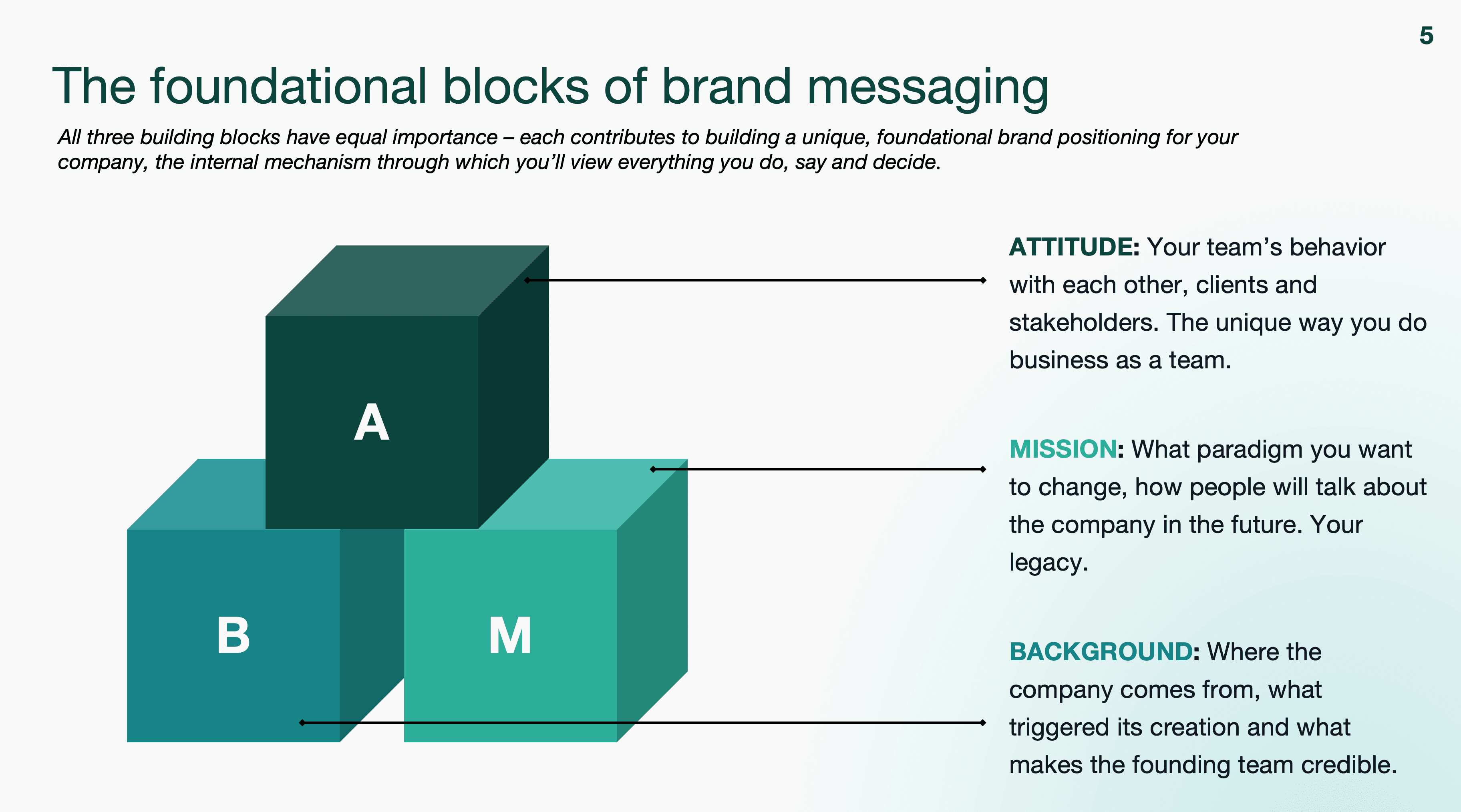
Most companies build their messaging framework in the wrong order.
They start with what they want to say, the benefits of the product, its features, the company's founding story - and work outward from there. The result is messaging that feels internally coherent but lands with a thud externally, and that's because it's built on assumptions rather than evidence.
A brand messaging framework isn't just a document. It's the foundation of your external and internal communications, sales collateral and marketing content. Get it wrong and everything downstream suffers. Get it right and the same budget produces materially better results, because every piece of communication is pulling in the same direction. Get the execution right alongside it and you earn a relentless trust loop that compounds your brand value.
Here's how to build a brand messaging framework that actually delivers.
What Is a Brand Messaging Framework?
A brand messaging framework is a structured document that defines how your company talks about itself - your positioning, your narrative, the proof points that support your claims, and the specific messages tailored to different audiences. It acts as the single source of truth for anyone speaking on behalf of the company, from your PR agency to your sales team to your CEO in a media interview.
A strong framework typically includes:
Your core positioning statement (who you are, who you serve, why it matters)
Your brand narrative (the broader story of what you're building and why)
Audience-specific messaging pillars (the 3-4 themes you return to, backed by proof points)
Your tone of voice and values
A spokesperson profile and comment bank for reactive media opportunities
What it is not: a tagline, a pitch deck, or a one-size-fits-all description of the company. The framework is the engine. Everything else is output.
Step 1: Start With Your Customers, Not Your Product
The most common mistake in building a brand messaging framework is starting with internal assumptions about what makes you different.
Before you write a single line of positioning, speak to the customers who already buy from you. Not to validate your own narrative - to discover how you feature in theirs. Ask them how they describe you when they recommend you to others. Ask what they were trying to solve when they first came to you. Ask what they'd say was missing from the market before they found you.
That language: unfiltered and unprompted will surface differentiation that isn't visible in your product but shapes how the right audience feels about working with you. It's often found in the outcome they experienced, the way you made them feel, or the risk you removed, rather than the feature list.
This customer research becomes the reference point for everything you build subsequently. If your framework isn't rooted in how real people already talk about you, it's marketing fiction.
Step 2: Map the Landscape Before You Build the Narrative
Once you understand how you're perceived, you need to understand the context you're operating in.
Mapping the landscape means identifying the boundaries of the category you're competing in (or creating), the macro trends that give your story relevance right now, and the competitors your audience is likely comparing you against. This isn't about following the market - it's about understanding enough of it to position yourself meaningfully within it.
This research shapes a narrative that's anchored in market reality rather than internal conviction. Journalists, investors, and customers don't evaluate you in isolation - they evaluate you against everything else they know. Your messaging needs to hold up in that context.
Use this step to answer three questions:
What's the problem we sit inside? Define the challenge at a market level, not a product level.
Why does it matter now? What trends, shifts, or failures have made the status quo untenable?
What makes our approach genuinely different? Not "we're better" — specifically different, in ways your customer research validates.
Step 3: Develop Messaging Audience by Audience
Here's where most messaging frameworks fall short: they treat "the audience" as a single entity.
In B2B, you're almost always talking to multiple stakeholders simultaneously - and the story that lands with a technical evaluator is materially different to the one that resonates with a commercial decision-maker, an internal champion, or an executive sponsor. Each of them has different fears, different incentives, and different definitions of a good outcome.
A proper brand messaging framework maps these audiences explicitly and builds specific messaging pillars for each, grounded in the same core positioning but shaped around what that particular stakeholder cares about.
For a technical evaluator, the message might be about integration reliability and developer experience. For a commercial decision-maker, it might be about ROI, payback period, and competitive risk. For an executive sponsor, it might be about strategic alignment and what it signals to the market.
Same company. Same product. Completely different emotional and commercial hooks.
This is also where tone diverges. The language you use in a technical blog post is different to how you show up in a trade feature or an executive briefing. Document those distinctions explicitly so your team doesn't have to make judgment calls in the moment.
Step 4: Build Documentation That Leadership Has Agreed On
A brand messaging framework only works if everyone uses it.
That sounds obvious. It almost never happens without deliberate effort.
The process of building your framework, ideally through a series of structured workshops with your leadership team, is as valuable as the document itself. It forces alignment on things that are rarely explicitly discussed: what the company actually believes, what it's willing to claim publicly, where spokespeople disagree, what the real differentiator is versus the aspirational one.
Get explicit sign-off from your leadership team on the final document. The framework should be genuinely compelling to the people who will use it, not something filed and forgotten. If your PR agency or content team doesn't reach for it constantly, it hasn't done its job.
The framework should also equip your team to say no. If a PR angle or piece of content doesn't map back to your messaging pillars, it probably isn't worth pursuing. The framework provides the strategic filter.
Step 5: Create a Reactive Comment Bank
One of the most underused applications of a brand messaging framework is reactive PR.
Your workshops will surface strongly held views: where your leadership has genuine expertise, what your company believes about the direction of the industry, what it's willing to argue for publicly. Capture those perspectives in a comment bank - a set of pre-developed positions on the topics most likely to emerge in your space.
When a relevant story breaks, you're not starting from scratch. Your PR team has something real to work with and can respond quickly, consistently, and in a voice that sounds like the company rather than a press release.
This matters for two reasons. First, reactive PR moves fast - if you need three rounds of approval and a redraft before you can respond, the window closes and our data shows us that speed of response time matters just as much as quality of content when journalists are up against a deadline. Second, spokespeople build relationships with journalists through consistency and directness. A comment bank to iterate from gives them both.
Over time, this is how your spokespeople stop being people who occasionally appear in coverage and start becoming genuine sources that journalists come back to. Ideally they'll build their own relationships with them directly.
Step 6: Map Where Influence Resides
The last piece of building an effective brand messaging framework isn't about the words - it's about understanding who carries weight with the audiences you're trying to reach.
This is a data challenge. You're looking for: which journalists are most influential in your space and are trusted by your prospective customers. Who in turn influences or has existing relationships with those journalists. Which events do the publications you care about actually attend, which voices in your industry shape opinion upstream of the purchase decision. Ideally you would analyse this stage by stage - imagine your funnel is a process of building trust from left to right. Who do you need at each stage to move a prospect from one stage to the next?
If you take a holistic approach to media relationship-building - building trust with journalists, partners, and influencers simultaneously - the credibility you develop compounds in a way that a linear approach to communications doesn't. A spokesperson who is consistently associated with credible, well-informed views on a topic becomes a reference point over time.
Your messaging framework should inform not just what you say, but who you say it through and where.
Putting It Together
A brand messaging framework is not a one-time deliverable. It's a living document that should evolve as your company, your market, and your audience understanding develops.
But the fundamentals, built on real customer language - shaped by market context, differentiated by audience, agreed by leadership, supported by reactive content, and deployed through the right channels - will give you something most companies don't have: a foundation that makes every PR and communications investment work harder.
If you're about to engage a PR agency or build an in-house communications function, run the workshops first. The time you invest at the start compounds through everything that follows.
Find out more about how MVPR works with scaling tech companies to develop brand messaging frameworks and develop PR strategies that drive measurable results. Book a free consultation to talk with one of our team about your messaging challenges.
Why Us
We believe in a world where our PR services are transparent, and data supports our strategic decision-making. Where clients own relationships directly with journalists. And where PR teams use AI in the right way.