PR How to's
April 2026

Tom Lawrence
Founder & CEO - MVPR
How to Do PR for Startups: A Practical Guide (2026)
By Tom Lawrence, Founder & CEO at MVPR
5 steps to start PR for your startup this week
Document your messaging - write your value proposition and 2-3 topics where you have genuine expertise
Build a focused media list - find 30 journalists across trade, tech, and business publications who cover your space
Create your first content - start with a contributed article synopsis or expert quotes on a trending industry topic
Pitch 10 journalists - personalise each email, keep it under 150 words, and use a soft call to action
Measure everything - track response rates, coverage rates, and publication quality from day one
PR has been kept deliberately opaque for decades. It’s suited PR professionals to maintain a layer of ambiguity over the media landscape - charging heavy retainers for relationships and processes that, at an early stage, aren’t that complicated.
This guide cuts through that. Whether you’re a pre-seed founder with no PR experience or a Series A CEO wondering when to invest properly, this is the practical playbook for doing PR that actually works - without spending £10,000 a month on an agency. The commercial case is clear: in our own data, cold outreach that references earned media coverage converts at 41x the rate of standard cold email. PR isn’t a vanity exercise - it’s a measurable pipeline multiplier.
I’ve spent 12 years in PR, including time at Edelman - the world’s largest PR firm - and I now run MVPR, where we’ve built AI-powered tools to make this process faster. But the principles here work regardless of what tools you use. They’re the same principles that have landed coverage in Forbes, Entrepreneur, MIT Technology Review, and VentureBeat for our clients and for ourselves.
When should a startup start doing PR?
Most startups start thinking about PR too late (after a funding round, scrambling for coverage) or too early (before they have anything genuinely newsworthy to say). Neither works well.
You’re ready for PR when you can answer “yes” to at least two of these:
You have a product that people are using (not just an idea)
You have a funding announcement, partnership, or milestone that others would find interesting
You have domain expertise that gives you a distinctive perspective on an industry trend
You’re hiring and need to build credibility to attract talent
If you’re pre-product with no traction and no funding news, PR isn’t your priority. Focus on building something people want first. If you try to pitch journalists with nothing concrete, you’ll burn contacts you haven’t yet earned - and first impressions with journalists matter.
One common fear - especially for technical founders - is saying the wrong thing publicly. Premature claims about partnerships, customers, or capabilities can backfire. The good news is that early-stage PR is predominantly expert commentary and thought leadership, where you control the narrative entirely. You don’t have to reveal anything you’re not ready to share. Start with what you know, not what you’re building.
The exception is thought leadership. If you or your co-founder have genuine expertise in a space, you can start building media relationships through contributed articles and commentary before you have hard news. Some of the most effective PR we’ve seen at MVPR comes from founders who established themselves as credible voices before they had a product to announce.
Understanding the media landscape your startup operates in
Before you pitch anyone, you need to understand who covers your space and what they actually write about. This is where most startups go wrong - they aim for the Financial Times and TechCrunch from day one, when neither publication would realistically cover them.
The media ecosystem has layers, and each serves a different purpose.
Trade publications are where you should start. These are the specialist outlets that cover your specific industry - fintech, healthtech, SaaS, climate, whatever your vertical is. They have smaller audiences, but those audiences are highly targeted: your potential customers, investors, and partners. The barrier to entry is also much lower. A well-pitched piece of expert commentary can land in a trade publication within a week.
Horizontal tech and business media - outlets like Tech.EU, Sifted, TechCrunch, Wired - cover the startup ecosystem broadly. They’re interested in your perspectives on building, growing, and scaling a company, not just your product. Think about what you know that a general business audience would find valuable: hiring mistakes, fundraising lessons, market observations.
National press - the FT, The Guardian, The Times - requires either a genuinely significant announcement (large funding round, major partnership) or a timely opinion on a story that’s already in the news cycle. Getting here takes time and credibility built through the layers below.
AI search visibility is the new layer that most people aren’t thinking about yet. ChatGPT, Perplexity, and Google AI Overviews are increasingly where your buyers go to research solutions. Coverage in credible, well-structured publications is what gets cited in AI search results. This means PR isn’t just about brand awareness anymore - it’s becoming a direct input into how potential customers discover you.
For in-house marketing teams, this means PR and SEO strategy should be running in parallel. The backlinks and citations you earn through media coverage directly fuel your search rankings - both in traditional search and in AI-generated answers. If your marketing team treats PR and SEO as separate functions, you’re leaving compound value on the table.
Building your media list: who to pitch and why
A good media list is 30–50 journalists, not 500. Quality of targeting beats volume every time. Here’s how to build one.
Start with your industry’s trade publications. Identify the 5–10 outlets that your customers, investors, and employees actually read. For each one, find the 2–3 journalists who cover your specific niche. Read their last 10 articles. Understand what they cover, how they cover it, and what gaps exist in their reporting.
Add horizontal tech and startup journalists. These are the reporters covering the broader ecosystem - startup funding, technology trends, business growth. Again, read their work before you reach out. Journalists change what they cover more often than you’d think, so your intel needs to be current.
Look for journalists who cover your topic, not just your industry. If you’re building an AI product for healthcare, you want the healthcare AI reporter, not just the general tech reporter. The more specific the match, the higher your response rate.
Track their recent activity. What have they published in the last month? If a journalist just covered a topic similar to your pitch, chances are they won’t want to cover it again immediately. Timing matters. If they covered something adjacent that your pitch could build on - that’s a perfect opening.
Maintain this list actively. We’ve found that founders who treat their media list like a CRM - updating it, noting what worked and what didn’t, tracking responses - get dramatically better results over time than those who treat each pitch as a one-off.
What to pitch: content that journalists actually want
PR content goes far beyond press releases. Most startups over-index on announcements and under-invest in the types of content that build lasting relationships with journalists.
Expert commentary and contributed articles are often your best starting point. If you have deep domain expertise - and as a founder, you almost certainly do - someone, somewhere will be interested in the insights you have to share. Don’t assume your company is too small for readers to care. If you’re bringing genuine value, journalists will be engaged.
Before writing any article in full, create a synopsis - a headline and the subheadings - and share the outline with the journalist first. This saves you enormous amounts of time. If the journalist is interested, they’ll often give you feedback on the direction they’d prefer. It’s a far better approach than spending days writing a piece that might not fit what they need.
Data and original research punch above their weight. If you have proprietary data - user behaviour, market trends, survey results - package it into something a journalist can build a story around. Data-backed pitches consistently outperform opinion-led ones.
Reactive commentary - responding quickly to breaking news in your space - is one of the fastest ways to build journalist relationships. When something happens in your industry and a journalist needs an expert quote by 5pm, being available and articulate is incredibly valuable. Many of our strongest journalist relationships at MVPR started with reactive quotes that took 15 minutes to draft.
Announcements - funding rounds, product launches, partnerships, hires - are the traditional PR bread and butter. They work, but they’re episodic. The companies that build real media presence combine announcements with a steady stream of the content above.
How to pitch: the mechanics that matter
Most pitches fail because they’re too long, too generic, or ask for too much. Here’s what actually works.
Keep it to three paragraphs maximum. Your pitch should contain: a personalised opening that shows you’ve read the journalist’s work, one paragraph explaining what you’re offering and why it’s relevant to their audience, and a soft call to action. That’s it. No company history. No product feature lists. No attachments on first contact.
The opening line is everything. Reference a specific article they wrote. Mention something they covered recently that your pitch relates to. Show that you’ve done your homework. “I enjoyed your piece on [specific article] - I wanted to share a perspective that builds on [specific angle]” is infinitely better than “I wanted to introduce you to [company name].”
Pitch the story, not the company. Journalists don’t care about your product. They care about stories their readers will find valuable. Frame everything around the reader: what will they learn? What will they understand differently? What will they be able to do that they couldn’t before?
Only claim what you can substantiate. If you have an NDA with a customer, don’t hint at the relationship and hope the journalist won’t dig. If your product data is preliminary, say so. Journalists respect honesty about what’s real and what’s aspirational. What they don’t forgive is being misled. Stay within what you can publicly stand behind - it protects both your reputation and the journalist’s.
Use a soft call to action. “Would this be of interest?” or “Happy to send more detail if this is something you’d cover” beats “Can we schedule a call to discuss?” or “Shall I send over our press kit?” You’re opening a conversation, not closing a deal. The first message generates interest only - no logistics, no fees, no attachments.
Time your follow-up carefully. Wait at least five days after your initial pitch before following up - less only if the topic is genuinely time-sensitive. Keep the follow-up short: “Checking you’d seen the below?” is enough. Don’t re-pitch. They have your original email. If you don’t get a response after a couple of follow-ups, move on with grace. You can always pitch different opportunities to the same journalist later. Don’t burn a bridge you’ve yet to cross.
Measuring PR: the metrics that actually matter
The biggest gap in most startup PR efforts is measurement. Without it, you can’t improve, and you can’t justify the time you’re spending.
Traditional PR measurement is broken. We’ve all seen reports claiming an announcement had a “reach of 40 million readers.” That’s not measurement - that’s fiction.
Be equally sceptical of any PR metric built on press release wire distribution. Services like Business Wire and PR Newswire will place your release on dozens of outlets - but those are paid syndications, not earned coverage. A journalist choosing to write about you because your story matters to their audience is fundamentally different from your press release appearing on a wire syndication page. If you’ve worked with an agency that counted wire pickups as “Tier 1 coverage,” you’ve been sold a vanity metric. When measuring your own PR, only count genuine earned placements where a journalist made an editorial decision to cover you.
Here’s what you should actually track:
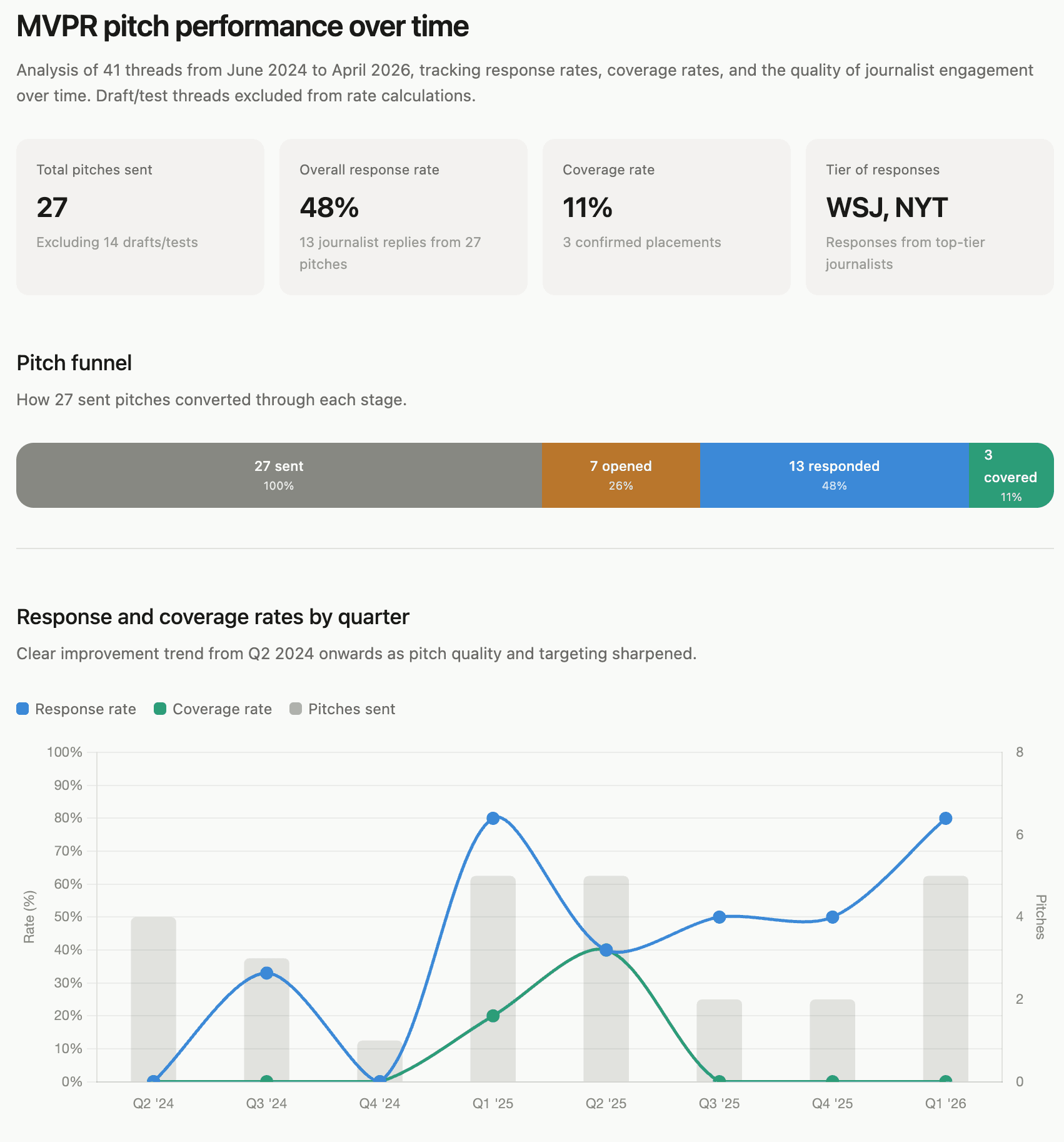
Response rate. What percentage of journalists you pitch actually respond? This tells you whether your targeting and pitch quality are working. If you’re below 15%, your targeting is too broad or your pitches need work. Above 25% and you’re in strong territory.
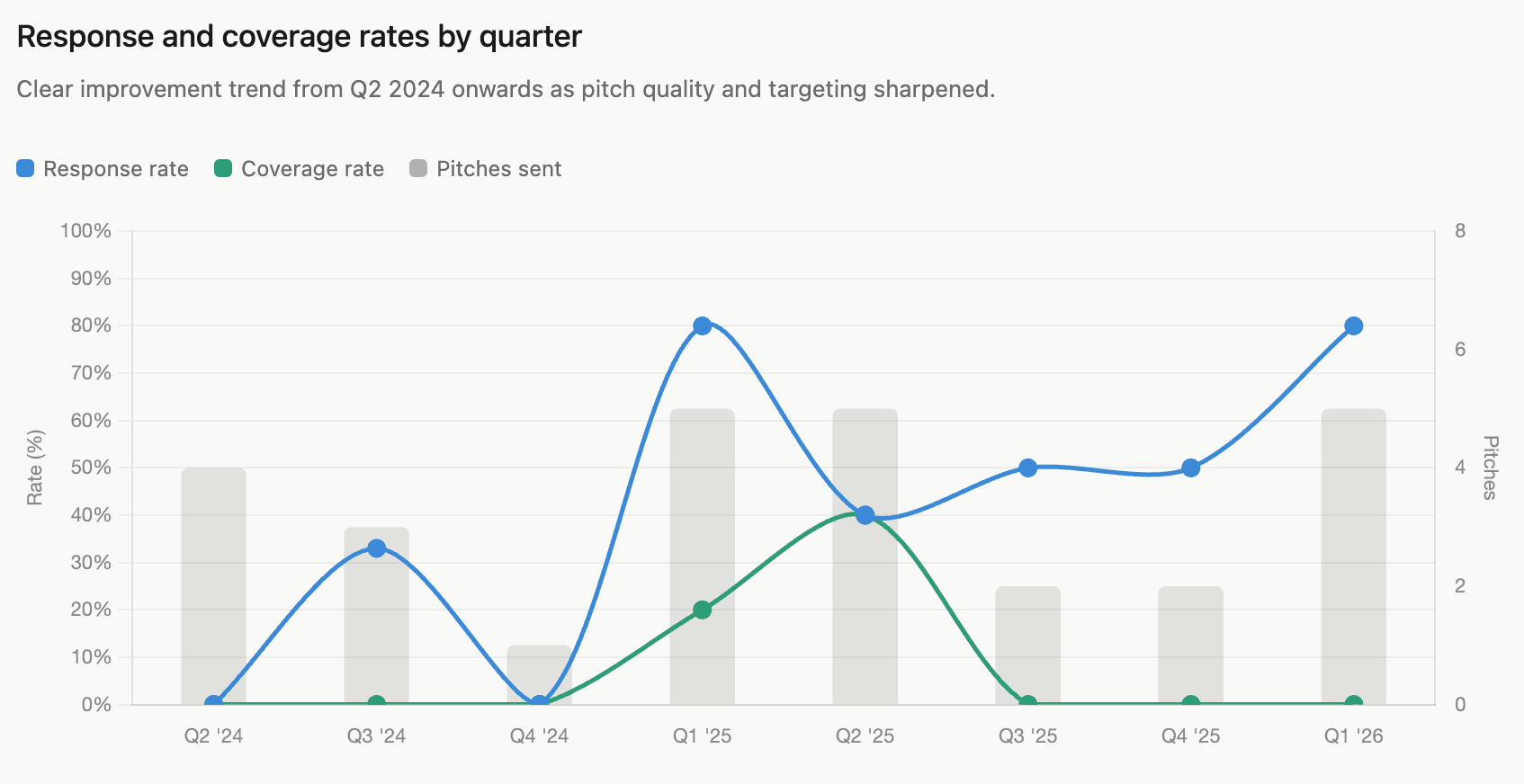
Coverage rate. The ratio of pitches sent to coverage secured. This is the single most honest indicator of PR performance. It’s the number we use as our north-star metric at MVPR because it combines targeting quality, pitch quality, and journalist relationship strength into one figure.
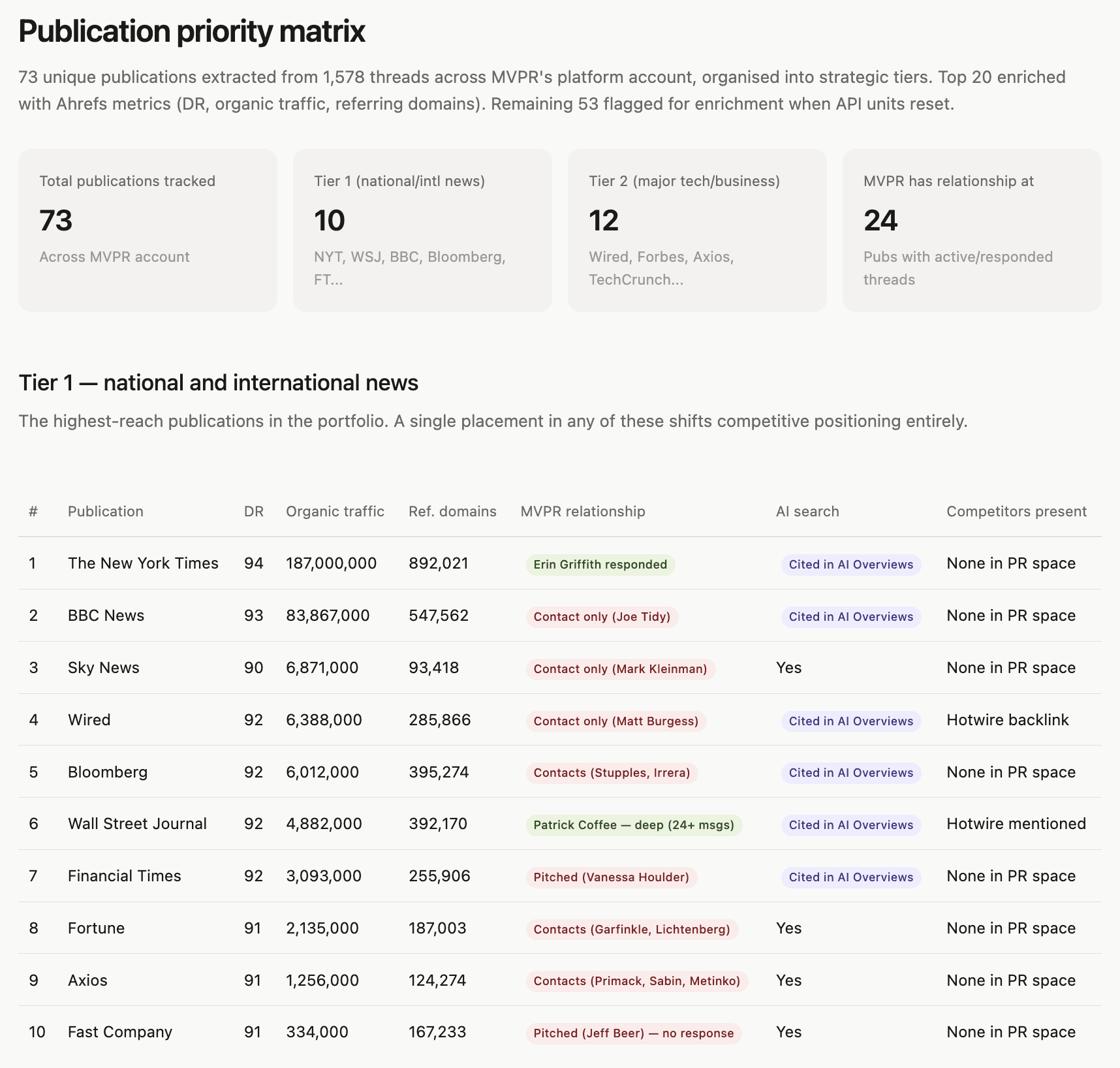
Domain authority of coverage. Not all coverage is equal. A placement in Forbes (DA 94) has a fundamentally different impact than a mention in a no-name blog. Track the average domain authority of the publications you’re getting coverage in, and how it is impacting your own brand's domain rating, and aim to increase it over time.
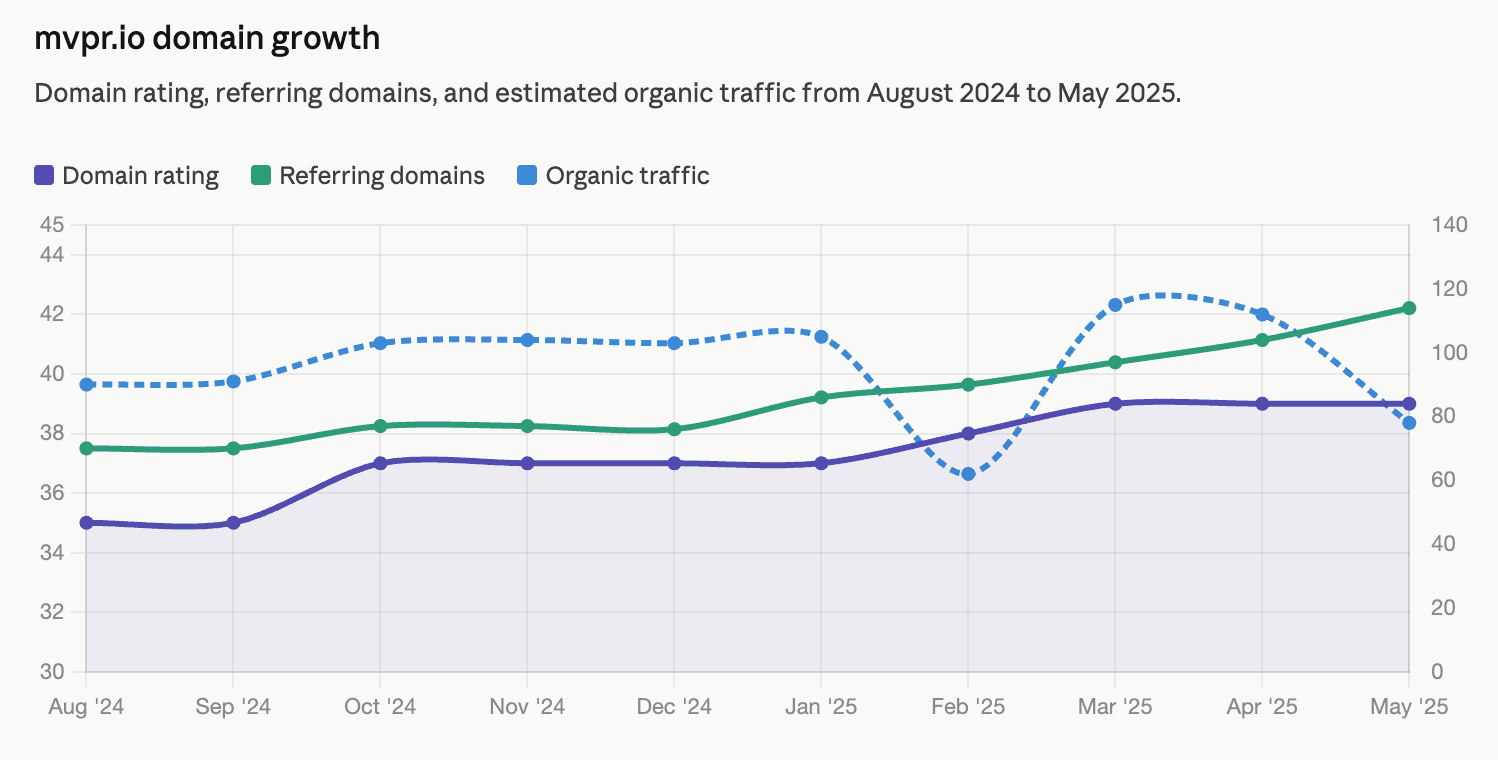
Referral traffic and backlinks. Use Google Analytics and a tool like Ahrefs to track how much traffic your coverage actually drives to your site, and whether the covering publication links back to you. A dofollow backlink from a high-authority publication is one of the most valuable outputs of PR - it directly improves your search rankings.
Downstream commercial impact. Ask prospects where they heard about you. Track whether leads who were exposed to your media coverage convert at higher rates. At MVPR, we’ve found that cold outreach that references media coverage converts at 12.1%, compared to 0.29% for standard cold email - a 41x improvement. That’s the commercial case for PR, expressed in numbers a startup board actually cares about.
If you’re reporting PR results to leadership - particularly in organisations where PR is seen as “fluffy” - lead with commercial metrics, not media metrics. Open with the conversion rate difference, the referral traffic numbers, or the backlink improvements to your domain authority. Then layer in the coverage volume and publication quality as supporting evidence. Speaking your board’s language - pipeline, CAC, conversion - is what turns PR from a nice-to-have into a protected budget line.
The cost question: agency vs. in-house vs. software
PR doesn’t have to be expensive. Here’s a realistic view of what different approaches cost:
Approach | Monthly cost | What you get |
|---|---|---|
Large agency | £8,000–£35,000/mo | 5-person team, 90–120 hours, 40 years’ combined experience |
Boutique agency | £5,000–£10,000/mo | 3-person team, 50–80 hours, 30 years’ combined experience |
Freelancer | £2,500–£4,000/mo | 1 person, 20–30 hours, 10–20 years’ experience |
In-house hire | £3,000–£5,000/mo (salary) | Full-time, 160+ hours, 4–7 years’ experience |
AI PR Software | £250–£1,000/mo | AI-assisted tools, distribution, measurement |
At an early stage, you don’t need a full-blown PR engine. You need enough to get your name into the right conversations and build credibility with your target audiences. That means 1–2 people with the right tools and the right data can achieve what a small agency team does - at a fraction of the cost.
A simple framework to get started this week
If you’ve read this far and want to start immediately, here’s the sequence:
Document your messaging. Write down your company’s core value proposition, the three things that differentiate you, and the two or three topics where you have genuine expertise. This takes an afternoon, not a week.
Identify your audiences. Who do you want your PR to reach - customers, investors, potential hires? This shapes which publications matter.
Build a focused media list. Find 30 journalists across trade, tech, and business publications who cover your space. Read their recent work. Note what angles they might be interested in.
Create your first piece of content. Start with a contributed article outline or a set of expert quotes on a trending topic in your industry. Don’t try to write a 2,000-word article from scratch - start with a synopsis and pitch the concept first.
Pitch 10 journalists. Personalise each email. Keep it under 150 words. Use a soft CTA. Wait five days before following up.
Measure everything. Track response rates, coverage rates, and the publications you land in. After your first month, you’ll have real data to improve against.
Then iterate. The companies that get the most out of PR are the ones that treat it as a continuous, measurable process - not a one-off campaign.
Ready to take your startup’s PR further? Talk to our team about how MVPR can help - or explore our startup PR services to see how we work with early-stage companies.
Sources used in this guide:
“PR Content Basics” - MVPR client education materials
“How to pitch journalists” - MVPR internal knowledge base
“Why Founders and CMOs Can and Should Pay Less for PR” - Forbes, October 2023
“How to Build Relationships with Journalists” - Hackernoon, May 2023
“How AI Decides What Answers to Share” - The AI Journal, August 2025
“The Best Digital PR Agencies in the UK” - MVPR, April 2026
MVPR software platform data and Ahrefs data analysis, April 2026
Why Us
We believe in a world where our PR services are transparent, and data supports our strategic decision-making. Where clients own relationships directly with journalists. And where PR teams use AI in the right way.