PR How to's
April 2026

Tom Lawrence
Founder & CEO - MVPR
Understanding what makes a story newsworthy is one of the largest early challenges for marketing teams starting to experiment with PR.
Here's a guide and tool to help you tell the difference before you waste a journalist's time - and your own.
If you've ever sent a press release into the void and heard nothing back, the problem probably wasn't your pitch. It was your story. Journalists don't ignore pitches because they're lazy. They ignore them because the story doesn't clear the bar for what makes something newsworthy.
After years of pitching stories across tech, fintech, AI, climate, and enterprise software, we've distilled what actually works into a practical framework. This isn't journalism theory - it's a working guide for anyone who needs to decide whether something is worth pitching, and how to make it stronger if it isn't.
The 7 Elements of Newsworthiness
The strongest stories contain two to four of these elements. One alone is rarely enough. If you can't identify at least two in your announcement, you're probably looking at a blog post, not a press story.
1. Timeliness
The story ties into something happening right now. A current crisis, a trending topic, an industry event, a regulatory shift. If your announcement exists in a vacuum - no external context, no reason it matters today - journalists will struggle to justify covering it. Ask yourself: why would this story matter more this week than last month?
2. Tension
There are clashing opinions, opposing views, or genuine controversy involved. You're disrupting an established industry. You're challenging incumbents. You have a contrarian thesis or a bold market bet. Tension is what makes a reader stop scrolling - the sense that something is being contested, not just announced.
3. Change
A twist on an old story, or the next phase of an ongoing trend. This is the "evolution" element - you're not starting from zero, you're advancing something people already care about. A pivot, a next-generation approach, a market that's entering a new phase. Change gives journalists a reason to revisit a topic they've covered before.
4. Surprise
Strange bedfellows, unexpected combinations, outcomes that defy market conditions. The partnerships nobody predicted. The results that shouldn't have been possible given the economic environment. Surprise creates the curiosity gap that drives clicks and coverage - the reader needs to understand how something happened.
5. Personal Impact
The story connects to people's lives or affects large numbers of people. How many people does your solution impact directly? Can you quantify the human benefit - time saved, money recovered, risk reduced? The more concrete and human the impact, the more a journalist can justify the story to their editor.
6. Prominence
The story is driven by a known figure, brand, or issue. Brand-name investors, recognisable customers, industry luminaries, or celebrity angels all add prominence. A Series A led by a top-tier fund is inherently more newsworthy than the same round led by unknown angels - not because the company is better, but because the signal is stronger.
7. Proximity
There's a local angle. The closer the story is to a journalist's audience, the more they care. Regional headquarters, local investors, community impact, industry-specific relevance. A fintech story pitched to a fintech reporter has proximity. The same story pitched to a generalist business desk doesn't, unless there's a broader angle attached.
What Actually Gets Covered
Elements of newsworthiness are the ingredients. But what does the finished dish look like? These are the story types that consistently generate media interest:
Category-defining innovation. A new capability that changes how an industry operates. The critical question journalists will ask: "Why does this matter now?" If you can't answer that in one sentence, the story isn't ready.
Product launches with real proof. Not a feature announcement - a new capability paired with live customers or beta users who can demonstrate results. Time saved, revenue impact, efficiency gains. Proof turns a product story into a market story.
Data and insights. Internal data at scale. Industry trends backed by new or surprising numbers. Original research that journalists can cite in their own reporting. 68% of journalists say they want original research and trend data from the companies they cover. Give them something they can't get elsewhere.
Major strategic moves. Acquisitions, significant integrations, market expansion, or a major senior hire from a recognisable brand. These are inherently newsworthy because they signal a change in competitive dynamics.
Customer wins. Recognisable brand names combined with a clear transformation story. "We signed a big client" is not news. "A Fortune 500 company replaced their legacy system with our platform and cut processing time by 70%" is news.
Funding announcements. Still newsworthy, but the bar has risen significantly. Strongest when combined with traction metrics, notable investors, and a compelling use-of-funds narrative. A pre-revenue seed round with unknown investors is a blog post. A Series A with clear product-market fit and a top-tier lead is a story.
What Does Not Make News
This is where most companies get it wrong. These announcements are much less likely to generate media interest unless they're tied to a bigger narrative or genuinely surprising data:
Feature updates and UI changes. Unless the feature fundamentally changes how an industry works, this is product marketing, not PR.
User milestones without broader significance. "We hit 10,000 users" is only news if those users represent something meaningful - a market shift, an adoption pattern, a data point that tells a larger story.
General points of view from leadership. An opinion piece only works if it's contrarian, data-driven, or tied to a breaking news moment. "Our CEO thinks AI is important" is not a story. "Our CEO thinks most AI investment is wasted - here's the data" might be.
Event announcements. Unless the event itself is the story, announcing your presence at a conference is not news.
Awards and rankings. With very few exceptions, winning an award does not generate press coverage. Use awards as proof points in other stories, not as standalone announcements.
Small funding rounds with unknown investors and limited traction. The funding market is noisy. Without recognisable names, strong metrics, or a compelling narrative, small rounds get lost.
Score It: A 10-Factor Newsworthiness Framework
Before you pitch anything, score it. Rate each factor from 0 (none/minimal) to 3 (exceptional). Maximum score is 30.
1. Customer Impact - How much does this improve customer outcomes?
2. Uniqueness - How differentiated is this from what already exists?
3. Metrics - How compelling are the quantifiable results?
4. Business Value - How relevant is this to C-suite decisions?
5. Technical Interest - How broadly will practitioners care?
6. Market Timing - How well does this align with current industry trends?
7. Customer Validation - Do you have a quotable customer success?
8. Competitive Position - Does this change your market standing?
9. News Hook - Can this tie to current events or trending topics?
10. Scale of Change - How transformational is this, versus incremental?
What Your Score Means
24-30: Tier 1 media. Embargoed journalist briefs, prepared spokespeople, exclusive offers to top-tier outlets. Start at least a week before your target date.
18-23: Tier 2 media. Targeted pitches to specialist and trade press. Three to five days of lead time.
12-17: Tier 3-4 media approach. Two days of preparation.
0-11: Owned media only. Blog, newsletter, social media, documentation update. Don't pitch this - you'll burn journalist relationships on weak stories.
This framework isn't about gatekeeping. It's about allocation. Every weak pitch you send reduces the impact of your next strong one. Journalists remember who wastes their time, and they remember who consistently brings them stories worth covering.
Try It: Get Your Newsworthiness Score
If your press release reads like marketing speak and isn’t actually “news”, it won’t get coverage.
Real, media-worthy news isn’t what companies want to say, it’s what journalists want to write. And in 2026, with most journalists struggling to filter the AI slop filling their inbox day after day, this distinction matters more than ever.
A lot of companies want to push out announcements that are internally important but externally irrelevant. They focus on features rather than impact.
We hope this tool can help show you the gap.
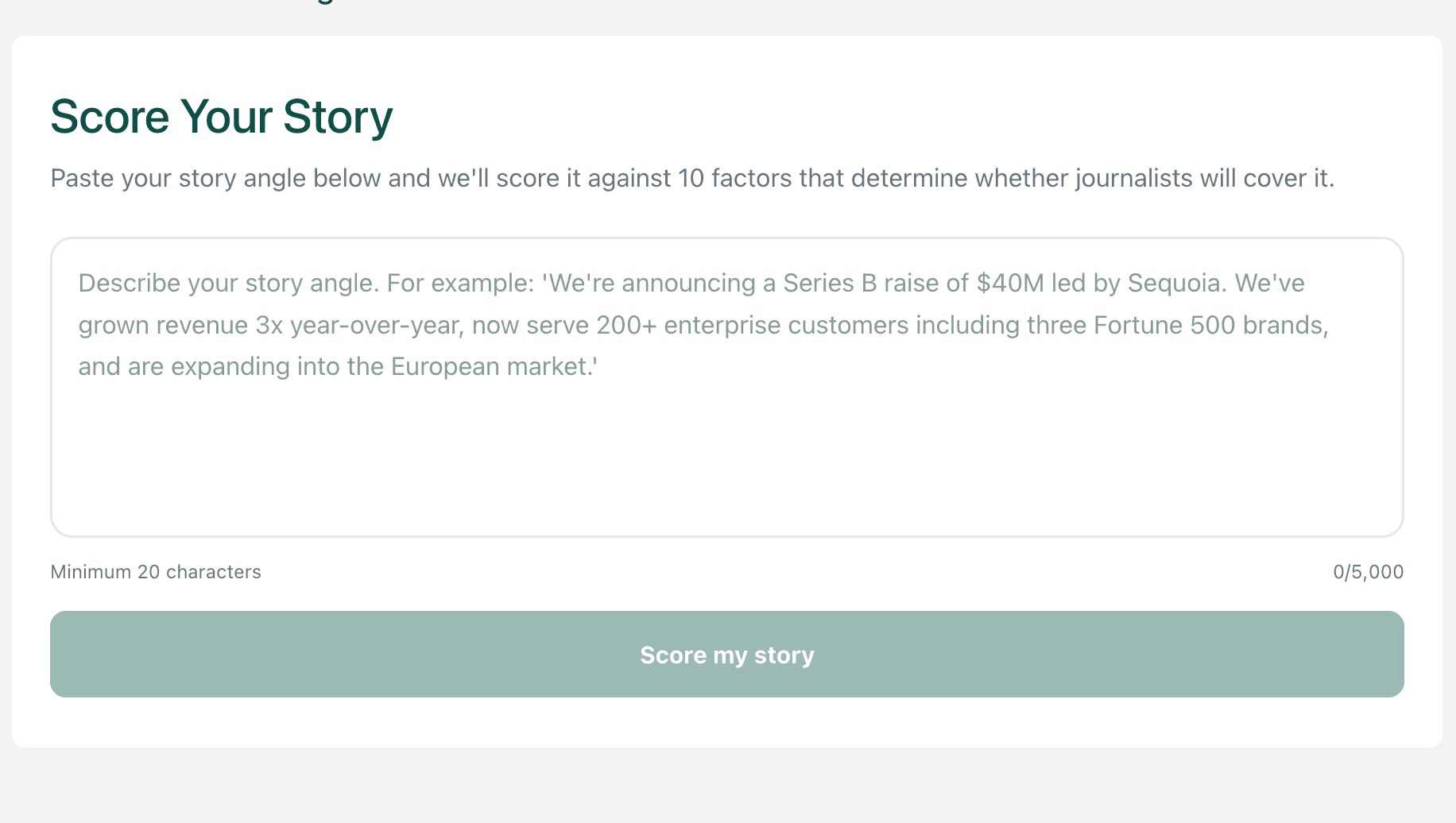
Drop in one of your announcements into the newsworthiness analyser and we’ll pressure-test it against what actually gets picked up in 2026 - so you can see whether you have a real story, or just a company update that’s better on Linkedin/X.
Your content is never stored, shared, or used to train our models. It’s processed securely and stays completely private.
When You Don't Have News: Finding Stories Between Announcements
Most companies go through long stretches without major announcements. That doesn't mean you go quiet. The best PR programmes maintain visibility between news moments using these approaches:
Newsjacking. When a major news event breaks in your industry, move fast. Tie spokesperson commentary to the breaking story within hours, not days. An energy technology company commenting on a national grid outage. An AI company responding to new regulation. Speed and relevance are everything - if you're not in a journalist's inbox within the first news cycle, you've missed the window.
Data stories. Mine your internal data for trends that would surprise your industry. Transaction volumes, adoption patterns, usage anomalies, seasonal shifts. Journalists need data to support the stories they're already working on. If you can be that source, you become a go-to contact - not just when you have news, but when they have news.
Expert commentary. Position your spokespeople as reliable sources on industry topics. This is a long game - it requires consistency, availability, and a willingness to comment on topics beyond your own product. But once a journalist trusts your perspective, they'll come to you first.
Reactive pitching. Respond to journalist queries through editorial calendars, HARO-style platforms, and direct requests. These are journalists actively looking for sources. Meeting them where they are is far more effective than pushing stories they didn't ask for.
Contributed content. Op-eds and bylined articles placed in target publications. The bar for contributed content is high - it must say something new, be backed by data, and avoid reading like a marketing brochure. More on this below.
The Thought Leadership Test
If you're writing contributed content - op-eds, bylined articles, guest posts - your piece needs to pass six checks before it's ready to pitch:
Is it unexpected? Say something new. If this topic has been covered extensively, your take needs a fresh angle. Tier 1 publications won't run something their readers have already seen elsewhere.
Is it relevant? Talk to your customers. Find out what keeps them up at night. The best thought leadership addresses real pain points, not theoretical ones.
Is it direct? One point, made well. Not two or three vaguely related arguments competing for attention. "Managing talent" is too broad. "Why a people person should be one of your first ten hires" is right.
Is it data-driven? Original data is gold. Credible third-party data is silver. Theoretical descriptions with no supporting evidence are bronze - and bronze rarely gets published.
Is it personal? Write as you'd speak. No jargon, no corporate voice, no AI-generated polish. A surefire way to get rejected is sending pitches that read like marketing materials. Journalists can spot them instantly.
Is it backed by influence? Quote others. Reference credible sources. Show opposing viewpoints. The strongest thought leadership doesn't just assert a position - it situates that position within a broader conversation.
At minimum, the first three need to be true. If your piece isn't unexpected, relevant, and direct, it's not ready.
Story Mining: 10 Questions to Uncover What's Newsworthy
If you're struggling to find stories, start with these questions. They're designed to surface the material that often exists inside a company but never makes it to the PR team:
1. What customer wins can you talk about publicly? Names, metrics, transformation stories.
2. What internal data would surprise your industry? Volume trends, anomalies, patterns nobody else is reporting.
3. What's changing in your product roadmap in the next six months?
4. Are there partnerships, integrations, or market expansions on the horizon?
5. Who on your leadership team has a strong, contrarian point of view?
6. What industry events or moments can you build commentary around?
7. What do your customers complain about that you've already solved?
8. What's a common industry assumption that your data proves wrong?
9. Are there senior hires from well-known brands joining your team?
10. What regulatory or market shifts affect your customers that you can credibly speak to?
Most companies have more stories than they realise. The challenge isn't usually a lack of material - it's a lack of process for surfacing it, scoring it, and deciding what's worth a journalist's attention.
The framework above gives you that process. Use the scoring matrix honestly, invest your pitching capital in stories that clear the bar, and build your thought leadership and data assets for the gaps between announcements. That's how you build a PR programme that generates consistent coverage - not just occasional spikes when the news is obvious.
Why Us
We believe in a world where our PR services are transparent, and data supports our strategic decision-making. Where clients own relationships directly with journalists. And where PR teams use AI in the right way.